

Buying a rental property can be a smart way to build long-term wealth, but getting a mortgage is not always simple. If you are self-employed, own several properties, or have income that changes from month to month, your personal tax returns may not tell the full story of your investment plans.
A Debt Service Coverage Ratio (DSCR) loan offers another financing option. Instead of relying mainly on your personal income, a lender looks at the rental income a property can generate compared with its housing payment.
For real estate investors in California, including Los Angeles, this type of loan may make it easier to explore financing for eligible rental properties. However, credit, available funds, property value, and other requirements still matter.
This guide explains what a DSCR loan is, how to calculate the ratio, what lenders may require, and how to decide whether this financing option fits your investment goals.
What Is a DSCR Loan?
A DSCR loan is a mortgage designed for real estate investors who want to finance a non-owner-occupied rental property. DSCR stands for Debt Service Coverage Ratio.
The ratio compares qualifying rental income with the property’s qualifying monthly housing expense. It helps a lender assess whether the property’s income can support its mortgage payment.
For example, imagine you want to purchase a rental home that is expected to bring in $3,000 per month. If its qualifying monthly housing expense is $2,500, the rent is higher than the payment used in the calculation.
This is the basic idea behind DSCR financing.
Unlike many conventional mortgages, which generally assess a borrower’s personal income and debt obligations, DSCR programs focus primarily on the property’s qualifying rental income. This can be useful for investors whose personal income documents do not fully reflect their investment plans.
DSCR loans are often classified as non-qualified mortgage (Non-QM) loans. They are generally intended for investment properties rather than homes you plan to live in.
A lender may still review your credit score, available funds, property appraisal, reserves, ownership structure, and other information. Approval is never based on rental income alone.
How Does a DSCR Loan Work?
The process usually begins with a rental property you want to purchase or refinance. The lender then reviews the property’s income potential and the proposed loan terms.
Here is how the process typically works.
- Identify the property. Choose an eligible rental property you want to purchase or refinance.
- Determine qualifying rent. The lender reviews an existing lease, market rent supported by an appraisal, or other accepted rental records.
- Calculate the housing expense. This commonly includes principal, interest, property taxes, insurance, and applicable homeowners association (HOA) dues.
- Calculate the DSCR. Divide the qualifying monthly rent by the qualifying monthly housing expense.
- Review the remaining requirements. The lender may assess credit, down payment, reserves, property condition, loan amount, and ownership documents.
- Complete underwriting and closing. If the application meets the applicable program guidelines, the loan can proceed toward closing.
The exact calculation and documentation requirements vary by lender and program. Some programs also offer no-ratio options, which use different qualification rules.
How to Calculate the DSCR Ratio
The DSCR calculation for many residential rental loan programs is straightforward.
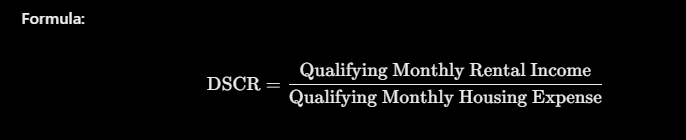
The housing expense often includes PITIA:
- P: Principal
- I: Interest
- T: Property taxes
- I: Insurance
- A: Applicable HOA dues or assessments
The lender determines which income and expenses are included in its calculation.
DSCR calculation example
Suppose you are considering a rental property in Los Angeles with the following figures.
| Item | Monthly amount |
|---|---|
| Qualifying rental income | $3,000 |
| Principal and interest | $1,900 |
| Property taxes | $350 |
| Insurance | $150 |
| HOA dues | $100 |
| Total monthly PITIA | $2,500 |
Using these illustrative figures:

The property’s DSCR is 1.20.
This means the qualifying rent is 20% higher than the included monthly housing expense. It does not mean the owner will earn a 20% profit, because other costs can reduce the property’s actual cash flow.
What if the DSCR is 1.00 or below?
- DSCR of 1.00: Qualifying rent exactly matches the included housing expense.
- DSCR of 0.80: If monthly qualifying rent is $2,000 and the housing expense is $2,500, the ratio is 0.80. Rent falls $500 short of that expense.
- DSCR of 1.25: Qualifying rent is 25% higher than the included housing expense.
These examples are for illustration only. Actual lender calculations and approval rules may differ.
What Is a Good DSCR Ratio?
A higher DSCR generally indicates that rental income provides more coverage for the property’s housing expense. However, there is no single minimum ratio that applies to every DSCR loan.
| DSCR ratio | What it means |
|---|---|
| Below 1.00 | Qualifying rent is below the included housing expense |
| 1.00 | Qualifying rent matches the included housing expense |
| 1.20 | Qualifying rent is 20% higher than the included housing expense |
| 1.25 | Qualifying rent is 25% higher than the included housing expense |
Some loan programs require a ratio above 1.00, while others may accept lower ratios under specific conditions. Certain programs offer no-ratio options with separate underwriting rules.
A higher ratio may help support a loan application, but it does not guarantee approval or a lower interest rate. Lenders also consider credit, equity, reserves, property details, and the full loan structure.
DSCR Loan Requirements
DSCR loan requirements vary by lender, transaction, property, and loan program. Before applying, understand the main factors that can affect eligibility.
1. Credit score
Lenders review your credit history and score to assess credit risk. A higher score may help you access more financing options, but the minimum depends on the program.
Druian Mortgage & Loans currently advertises a minimum FICO score of 660 for its stated DSCR program, with alternative scenarios available for review. This is a program-specific guideline, not a universal industry requirement.
2. Down payment and loan-to-value ratio
Most DSCR purchase loans require the investor to contribute some of the purchase price. The required amount depends on the property, loan program, credit profile, and other factors.
Druian advertises a maximum combined loan-to-value ratio (CLTV) of 80% for its stated program. Do not assume that every borrower or transaction will qualify for this maximum.
3. Rental income
The lender needs an accepted way to assess the property’s rental income. This may involve an existing lease, market rent from an appraisal, or other approved documentation.
Expected rent should be realistic for the property and local rental market.
4. Cash reserves
Some programs require funds to remain available after closing. These reserves can help cover mortgage payments during vacancies or unexpected expenses.
The required amount depends on the loan program and the borrower’s circumstances.
5. Property eligibility
The property must meet the lender’s rules for property type, occupancy, condition, and rental use. Standard DSCR programs generally focus on non-owner-occupied investment properties.
6. Loan amount and transaction type
Requirements may change depending on whether you are purchasing a property, refinancing an existing loan, or completing a cash-out refinance. Larger loan amounts can have additional conditions.
7. Ownership structure
If you plan to purchase through an LLC, the lender may require company formation documents, ownership information, and other records. Personal guarantees or additional conditions may also apply.
Review all requirements with the mortgage provider before committing to a property purchase.
Can You Get a DSCR Loan Without Tax Returns?
In many DSCR programs, you do not need to qualify using personal tax returns or pay stubs in the same way you would with a conventional mortgage.
Instead, the lender primarily evaluates the rental property’s qualifying income and housing expense. This can be helpful for self-employed investors or borrowers whose reported personal income does not fully reflect their investment activities.
However, no personal income documentation does not mean no documentation at all.
Depending on the program, you may still need:
- A property appraisal and rental income assessment
- Lease agreements or accepted rental records
- Bank statements or proof of available funds
- Credit information
- Property insurance and title documents
- Identification and entity records, where applicable
Druian Mortgage & Loans advertises reduced personal income documentation for its DSCR program in most cases. Confirm the current requirements for your specific application before proceeding.
What Types of Properties Can Qualify for a DSCR Loan?
DSCR loans are generally intended for eligible rental investment properties. Depending on the program, property types may include:
- Single-family rental homes
- Duplexes
- Triplexes
- Fourplexes
- Certain short-term rental properties
Druian’s advertised program covers eligible rental properties ranging from single-family homes to fourplexes (one to four residential units). Its website also identifies short-term rental financing as an available option, subject to program guidelines.
Not every property automatically qualifies. Lenders may assess the property’s condition, rental history, expected income, location, and legal use.
Standard DSCR investment loans generally do not cover a primary residence that the borrower intends to occupy. Confirm occupancy rules before choosing a loan program.
Can You Get a DSCR Loan Through an LLC?
Yes. Some DSCR loan programs allow eligible investors to purchase or hold rental properties through a limited liability company (LLC).
An LLC may help investors organize property ownership and manage certain business responsibilities. However, its legal and tax effects depend on the investor’s situation and should be reviewed with qualified professionals.
When financing through an LLC, the lender may ask for:
- Articles of organization or formation documents
- An operating agreement
- Information about LLC owners and authorized signers
- Business-purpose or occupancy documentation
- Personal guarantees, where required by the program
Druian Mortgage & Loans advertises the option to close eligible DSCR loans in an LLC. The final ownership structure must meet the lender’s requirements.
If you plan to use an LLC, discuss the structure with your mortgage provider before closing. Consult a qualified attorney or tax professional for legal and tax questions.
Benefits of DSCR Loans for Real Estate Investors
DSCR financing may be useful for investors who want to purchase or refinance rental property without relying primarily on personal income calculations.
Potential benefits include:
- Property-focused qualification: The lender emphasizes qualifying rental income and the property’s housing expense.
- Reduced personal income documentation: Many programs do not require traditional personal income documents for the main qualification calculation.
- Options for self-employed investors: Borrowers with variable or complex income may find this structure useful.
- Portfolio growth opportunities: Investors can explore financing for additional eligible rental properties.
- Purchase and refinance options: Depending on the program, DSCR loans may support purchases, rate-and-term refinances, or cash-out refinances.
- LLC ownership options: Certain programs allow eligible borrowers to close through an approved business entity.
These are potential advantages, not guaranteed outcomes. The actual benefits depend on the loan terms, property performance, and the investor’s financial goals.
Limitations and Costs of DSCR Loans
DSCR financing is not the right choice for every investor. Compare the full costs and risks before making a decision.
Interest rates and fees: DSCR loan pricing may differ from conventional investment property financing. Compare the interest rate, origination charges, closing costs, and other fees.
Down payment and reserves: You may need a substantial amount of money for the down payment, closing costs, and post-closing reserves.
Weak rental coverage: If qualifying rent does not cover the included housing expense, some standard programs may not accept the application. Other programs may offer alternative structures with different costs or conditions.
Vacancy and maintenance: The property may need repairs, experience periods without tenants, or generate less rent than expected.
Changing expenses: Property taxes, insurance, HOA dues, and maintenance costs can affect your returns over time.
Approval requirements: A property with strong rental income may still fail to qualify if other credit, property, equity, or documentation requirements are not met.
Before purchasing, estimate the property’s full operating costs, including vacancy, repairs, management, and maintenance. The DSCR ratio is a useful financing measure, but it is not a complete investment profitability calculation.
DSCR Loan vs. Conventional Investment Property Loan
Both loan types can help finance rental properties, but they may assess borrowers differently.
| Feature | DSCR loan | Conventional investment property loan |
|---|---|---|
| Main qualification approach | Primarily property rental income and housing expense | Generally borrower income, debts, credit, and property details |
| Personal income documents | Often reduced or not used for primary qualification | Usually required |
| Rental income | Central to the DSCR calculation | May be considered under program-specific rules |
| Debt-to-income ratio | May not be used in some DSCR programs | Commonly part of borrower qualification |
| Property purpose | Eligible rental investment properties | Eligible investment properties, as well as other permitted uses under different programs |
| Potential advantage | May suit investors with complex personal income | May offer competitive terms for eligible borrowers |
| Potential limitation | Pricing, down payment, and reserve requirements may be higher | Personal income and debt requirements may limit eligibility |
Neither option is automatically better or cheaper. Compare the actual interest rate, fees, loan term, down payment, and qualification requirements for your situation.
If you have strong documented personal income and qualify for conventional financing, it may be worth comparing that option with a DSCR loan before deciding.
When Should You Consider a DSCR Loan?
A DSCR loan may be worth exploring if:
- You are self-employed and your personal income documents do not fully reflect your financial position.
- You want to purchase a rental property based primarily on its income potential.
- You already own rental properties and want to explore financing for another investment.
- You plan to purchase or refinance an eligible property through an LLC.
- You want to compare rental-focused financing with conventional mortgage options.
- You are considering a cash-out refinance and want to understand the available options.
It may be less suitable if the property has weak rental income, the financing costs are too high, or another loan program offers better terms for your circumstances.
The best choice depends on the property’s expected cash flow and your broader investment goals.
How to Explore DSCR Loan Options in California
If you are considering an investment property in Los Angeles or elsewhere in California, start by estimating the property’s rent, monthly housing expense, and other operating costs.
Then compare available loan programs to understand the required down payment, interest rate, fees, credit requirements, and reserves.
Druian Mortgage & Loans offers DSCR financing options for eligible rental investment properties, including purchases and refinancing. Its advertised program includes properties with one to four residential units, financing up to $2 million, and an option to close through an LLC, subject to program guidelines.
You can learn more about the available options on the company’s DSCR loans in Los Angeles service page.
Before contacting a mortgage provider, it helps to prepare:
- The property’s purchase price or estimated current value
- Expected monthly rental income
- Estimated property taxes and insurance
- HOA dues, if applicable
- Your approximate credit score
- Available down payment and reserve funds
- Your preferred ownership structure
These details can help the team understand your scenario and explain which financing options may be worth exploring.
For questions about your situation, visit the Druian Mortgage & Loans contact page. Loan availability, terms, and approval depend on the applicable lender and program.
Frequently Asked Questions About DSCR Loans
1. What is a DSCR loan in simple terms?
A DSCR loan is a mortgage for an eligible rental investment property that focuses mainly on how the property’s qualifying rental income compares with its housing expense. It may be useful for investors who do not want to qualify primarily through personal tax returns or pay stubs. Credit, property eligibility, down payment, reserves, and other conditions still apply.
2. What DSCR ratio do you need to qualify?
There is no universal minimum DSCR ratio. Some lenders require qualifying rent to exceed the included housing expense, while other programs may accept a ratio below 1.00. Certain programs offer no-ratio options with different rules. The minimum depends on the loan program, property, credit profile, and transaction details.
3. Can I get a DSCR loan without tax returns?
Many DSCR programs do not rely on personal tax returns or pay stubs to calculate qualification based on personal income. However, you may still need rental income records, an appraisal, credit information, proof of funds, and property documents. Ask the lender which records are required for your selected program.
4. How much down payment do I need for a DSCR loan?
The required down payment depends on the lender, loan-to-value limit, credit profile, property type, and loan purpose. Druian Mortgage & Loans advertises a maximum CLTV of 80% for its stated program, but this does not guarantee that every applicant can borrow that percentage. Confirm your actual down payment and closing fund requirements before making an offer.
5. Can I use a DSCR loan to buy a property through an LLC?
Some DSCR programs permit eligible investors to close through an LLC. The lender may require formation documents, ownership details, an operating agreement, and other records. Guarantees or additional conditions may apply. Confirm the lender’s entity requirements and consult a qualified attorney or tax professional about the legal and tax effects of LLC ownership.
6. Can a first-time real estate investor get a DSCR loan?
Yes, some programs accept first-time real estate investors, although eligibility depends on the lender and loan terms. Druian’s DSCR service page identifies first-time investors as acceptable for its advertised program. You will still need to meet the applicable credit, property, income, equity, and documentation requirements.
7. Can I refinance a rental property with a DSCR loan?
Many DSCR programs allow eligible investors to refinance rental properties. Depending on the program, options may include refinancing an existing mortgage or completing a cash-out refinance. The lender may assess the property’s current value, qualifying rental income, equity, credit, and other requirements. Confirm the available terms before relying on expected proceeds.
8. What happens if my rental income is lower than my mortgage payment?
If qualifying rent is lower than the included housing expense, the property’s DSCR will be below 1.00. Some standard programs may not accept that ratio, while certain specialized or no-ratio programs may offer alternatives. Even if financing is available, you should assess whether you can cover the shortfall, vacancies, repairs, and other operating expenses.
Conclusion
A DSCR loan can give real estate investors another way to finance eligible rental properties. Instead of relying primarily on personal income documentation, the lender focuses on the property’s qualifying rental income compared with its housing expense.
Understanding the DSCR formula, down payment, credit requirements, reserves, loan costs, and property eligibility can help you compare financing options before committing to an investment.
If you are exploring a rental property in California, review the available DSCR loan options in Los Angeles and discuss your property’s rental income and financing goals with Druian Mortgage & Loans.